I Used SEO to Build an AI Startup Worth Six Figures
Video transcript, 17:18
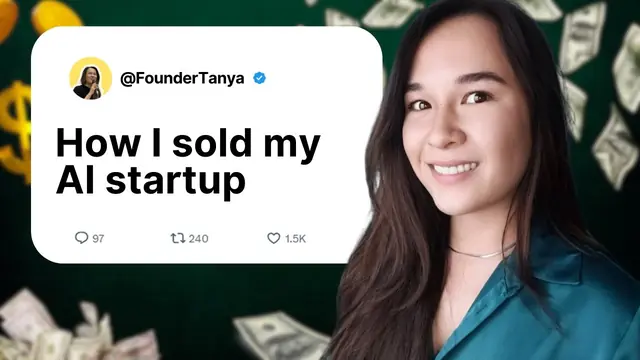
Tanya Van Gastel recorded this video a few weeks after selling The Multiverse AI, the AI headshot company she co-founded and grew to about $350,000 in revenue through organic marketing. She answers the questions people sent her about the sale: how it happened, what she wishes she had prepared earlier, and what an asset purchase agreement actually is. It is a practical video with a personal ending about celebrating a small exit.
Key points
- The Multiverse AI reached about $350,000 in revenue in two years at roughly 70% profit margins, almost entirely through SEO and affiliate marketing.
- A company can sell at almost any price if it has revenue and you know how to sell; an exit is not the same as being set for life.
- Start your profit and loss statement and admin work early. Getting the books together took far longer than expected.
- Buyers understand cash flow, not your pitch: your P&L has to tell the story of your business.
- The Multiverse AI sold through an asset purchase agreement (website, brand, customers, infrastructure), not a share purchase of the whole entity.
- Put co-founder agreements and equity splits on paper before anything happens.
- Go easy on yourself: a small exit is still a win.
I sold my AI startup
Hi guys, I sold my AI startup. It still feels kind of crazy to say, but I guess that's kind of where we are. I posted about it on LinkedIn when it happened a couple weeks ago now, and I got I'm looking for it. And I got a bunch of reactions from you guys.
And it was so fun and nice and interesting to hear about how interested you guys were in hearing about the experience in how we were able to sell how we built the company and everything. And so I thought I'll make a little video about it and give you guys some of like the overview. So maybe first things first, what was the company? Show you on my screen as you go along because that is easiest for me to edit.
What The Multiverse AI was
So the company was called the Multiverse AI. The company is called the Multiverse AI. We started it 2 years ago, me and two co-founders and we launched about like April 2023. The 6 months prior to that, I was still also working full-time. And so I was spending a lot of my time after work building this out, working on the AI models, thinking about the positioning, all of that. And then we launched in that April.
We initially kind of launched with a different product. It was more about seeing yourself in like different movie scenes and stuff like that. And then we slowly pivoted to being about professional head shot. And so you can see here kind of like the landing page. And that's kind of that. We did about 350,000 in revenue in like the last 2 years. I'm going to share a video very soon, I think next week, about how we got to that level.
We did it on super high profit margins like I believe it was 70% profit margins. It was like 60 to 70 I think it was 70% profit margins and that was because we were able to do complete organic marketing. So that was through SEO affiliate SEO and affiliate mostly and there's some like people who really helped us so much and I'm also going to talk about that in this upcoming video.
So please subscribe to stay tuned and see how you can also grow organically with your company. In total, I think we did about 350,000 revenue in about 2 years. And we sold for less than that total sum, but still a six figure sum, which I will not exactly disclose because I've been advised against it. But if you ask me nicely, maybe I will tell you. So, I Let's go over questions. Okay. So, let's start answering some questions.
What is the secret sauce?
I'll answer some questions about the, you know, how did I sell? What is my secret sauce? Such an interesting question. What is my secret sauce? I don't really know. What is my secret sauce? So, I think when it comes to selling your startup, there are a couple of different things that are really important that people maybe don't really talk about. I just plugged in my mic. So, let's get to the questions. What is my secret sauce?
There's a couple of things here. So, I would say when it comes to selling, it's really important that you understand a couple of different things. You need to understand that your company can sell at any price, but actually you can almost always sell your company if you have some revenue in the bank and also you know how to sell. So, you know, when people say exit, they think, "Oh, you know, that person's a millionaire." No, like they're off the hook.
They can just kind of like relax and sit on a beach and like do nothing forever. I can tell you 100% that is not the case. There are many different types of exits. You can sell for a dollar, you can sell for 100, a,000, 10,000, 100,000, and then of course far beyond that. Accidents happen at any single at any given price. And so that's a good thing and a bad thing.
It means that whatever business you are running, you could actually think about selling it. And what would that look like?
Start your P&L early and list on Flippa
And so here's a huge tip that I would give you. You need to start your P&L and you need to start your administrative work as soon as possible. Why is that? So there are there are platforms like Flippa and Flippa is actually the platform that we used. We had the luck of having a really great broker. She was super helpful. And so, basically, Flippa is this platform to buy and sell anything, blogs, SAS, e-commerce, all of that.
This is what we used also. I still have some like messages. Outstanding. This is what we used also to sell our business. So, you basically list it. And when you list it, you need to put in all of the income as well as expenses that you have. So the buyer can see and understand what your business is structured like, what the profit margins are, where expenses are going to and everything. You can do all of that also anonymously.
I believe you can list it so that people have to sign like an NDA which is just a click of a button to then see more details about your business. It's a very powerful way to get in touch with a huge network of buyers and I really recommend it. But before that you really want to start your P&L especially if your business is a little bit bigger. So again what is your P&L? Your P&L is your profit and loss statement.
Here your P&L is your profit and loss statement. It outlines a company's revenue costs and expenses over specified period of time to months to clear this. It was such a big difficulty. Part of that maybe because of the accounting like administrative agency that we worked with. Part of it potentially because it was our first time to get everything together, but it really just took so much time.
So, I would really highly recommend for people to get started on doing that properly first, especially if you're in between like tax years where maybe you don't have all of your invoices ready yet. Get started on that much sooner than you would potentially think. And here it brings me to my next point.
Study your P&L: it tells the story
Really study that P&L. So, you really want to study that P&L because your P&L tells a whole story about your business. I didn't understand this. I was like, "Lady, I'm telling you this is a great business. This is where our money comes from. This is where it goes to. This is that. This is blah." It doesn't matter. Ultimately, an investor understands money, understands cash flow, and doesn't understand your business.
And it is your job to show them and tell them what the story is of your business. You don't do that with a PowerPoint. You do that with your P&L and you do that with your financial reports. So, what do I mean with that?
A buyer could ask you something like, "Oh, what is this item in like the shipping category?" you know, 30 like maybe not 30 but like 17 months ago and somebody actually asked me that and I couldn't immediately answer that question because I honestly just didn't remember at all. So I needed to go and really like kind of study so I could be able to answer those questions on those meetings when they needed that question answered.
So your financials just tell a whole story about your business. It tells a story about the marketing investments you've made, tech costs that like ramped up or down, competitors that maybe even like entered the scene and took market share, or revenue that fluctuated because of an SEO keyword ranking.
All of that in some regard is reflected in your P&L and you want to be super freaking clear about how you tell that story to the buyer so they can understand exactly what they are buying because this is a story that your buyer's really interested in. Another note about the exits is that I have a friend her name is Cat. You may have seen her on like Twitter.
She has like a pretty big following and she talks a lot about micro exits which is I think exits under like six figures or you know kind of like smaller range but she's so good at doing these micro exits. I think she's had like five and it's super inspiring to hear her talk about it. I'll link something down below so you can find more content about that.
SPA versus APA
Another one is you want to understand the difference between an SPA and an APA. So, this is a little bit more like technical, but basically when you are selling a company, you need to understand what you are selling. In your head, you're like, "Oh, I'm just selling everything, you know, like just, you know, then I'll take it." But what does that actually mean? Are you selling your whole legal entity along with it or are you selling your assets?
And so in our case, we were selling our assets. So it was structured through an APA. Selling your assets means that you sell your website, your brand, your social platforms, your customer list, tech infrastructure, even like the one freelancer that we had hired for customer service. It's basically your Stripe, your AWS, your Ghost, but it doesn't include your bank your bank or your like admin structure. That's kind of like your company if you will.
So with an SPA, that's a share purchase agreement, you do that. The company, the buyer's company takes ownership of everything, your legal entity, your assets, your liabilities, the whole package. Whereas with an APA, the asset purchase agreement, it is only buying specific assets from your company. And that's kind of what we did. As far as I understand, usually startups are bought through an SPA, especially when they want to continue it on.
So in like, you know, the big startup arena, you will think of Facebook buying WhatsApp, right? So that was very likely an SPA because the company kind of like continued on. It retained the whole team. It got all outstanding shares and it allows for like full absorption basically without any stop especially in bigger companies. It doesn't really like it's not that important for like smaller companies like ours.
But then there's also the APA which is probably more like for example how Grammarly bought Superhuman very recently that was very likely an APA because you know superhuman team was kind of transition to Grammarly and then I think it was fully integrated. So again to be clear our deal was very small compared to these giants but I hope that kind of illustrates how it works. Lastly, how do you lastly?
I guess like there's two more things that I learned that I think may be helpful for you.
Paperwork between co-founders
One is paperwork. This is very boring. This whole video is a bit more technical than I kind of wanted it to be, but paperwork is really important. What I mean with paperwork is co-founder agreements, agreements on equity. What changes if one party decides to stop wanting to collaborate? What changes when you know somebody is when somebody gets like an emergency situation? What changes in different like scenarios? What changes if somebody just wants to leave the organization?
What changes if you know anything happens in terms of like emergencies or things that are unforeseen. You could have you know the best oh my god you could have like all the conversations that you want but really make sure that things are on paper. That paperwork is super important because it can help you navigate any kind of conversations and avoid miscommunications because ultimately you will sell your company and then you have the equity split.
And so that basically means even if you know your sale was let's say like 1 million even if you only have if you only have like 5% of that 1 million because of some I don't know structure that you guys had set up together. If you have 5% of that 1 million you'll really only get $50,000 for it. Is that math right? Yeah it is. That's definitely something to like keep in mind for everything.
I think for like healthy partnerships of any kind. What else?
Go easy on yourself
I guess the last thing is like I don't know like go easy on yourself, you know, because I feel like even for me, you know, I now have sold this startup. I am technically like an exit founder.
It doesn't feel any different, you know, and I think I have like a little voice in my head that is like, "Oh, but it was just like a little small exit." And then, you know, sometimes people congratulate me on it and I'm like, "Thank you so much." Like, "That's really nice." But I don't, you know, I I'm still like kind of saying things. Sorry, let me get back.
So, sometimes people congratulate me on it like, you know, at a party or at drinks or stuff like that, and I'm always like, "Oh, yeah. Thank you so much." But, you know, it was very small and kind of like apologetic and I don't want to do that. You know, I feel like I'm like subconsciously putting myself down instead of like celebrating it because it was like a small one. But there's no need, you know, a win is a win.
And so, go easy, you know, like don't put so much pressure on yourself. Try to just like really enjoy the process of building. Yes, we struggle and you know founders are anxious a lot of time like very perfectionistic or very like visionary and want to get everything done like immediately but man relax like honestly probably it will all work out. You're already achieving all the dreams that you like set out to achieve 5 years ago, you know?
Like I literally did this thing recently where I just like listed out all of the stuff in like a little notebook. Find it. I listed out all of the stuff in like a little notebook of like things that I've like done this year and like achievements and goals that I wanted to achieve for 2025. And like literally we're halfway and it's all done. It's like 90% of it is like ready. So yeah, I think go a little easy on yourself.
Maybe just like say no to one or two things that you're doing that maybe it's just a little bit too much pressure and instead take like a little nap or something like that.
What I did with the money
Some people also ask me what I what did I do with the money. So what I did is I got a Ninja Creamy ice cream maker. Let me show you what this is. It's basically an ice cream maker that can like make really delicious ice cream. It's like high protein ice cream that I'm making because it's hot out, but I have protein goals. And it's really great and delicious. It's hella loud though.
It's a lot louder than I thought it would be. But you know what? I love it and it's awesome. And let me show you actually. It's awesome and I love it. And also, I let myself sleep in till like 900 a.m. Or 10:00 a.m. On weekdays this summer because we got a little bit little yeah, let me know if you have any other questions. I'm going to have a video out soon.
It's already recorded about how we grew the Multiverse AI to our the revenue that we did. And I will let you guys know what's going to happen with me soon and all of that because I am working on a next thing. So, have a great day everybody.
Transcript lightly edited for readability: filler removed, punctuation and names fixed, her wording kept. All video transcripts.