The AI Visibility Playbook Used by 9 Figure SaaS
Video transcript, 27:17
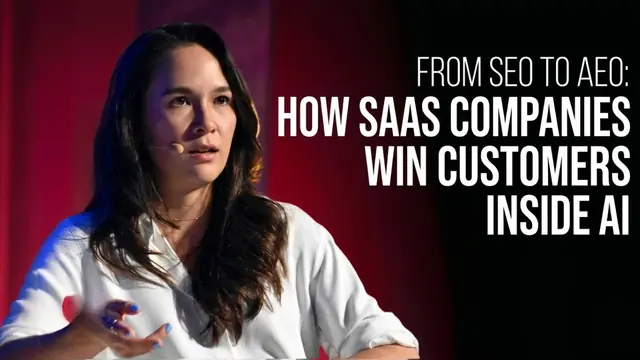
This is the full recording of the 4YFN Founders Stage panel at MWC Barcelona 2026, From SEO to AEO: how to build a revenue engine. Tanya Van Gastel joins David Tomás of Cyberclick, moderated by Eugenia Dunaeva. They discuss why the next one to two years are a window for startups, how much of AI visibility is simply good SEO, which off-site placements matter, and how to measure something that changes with every prompt.
Key points
- Startups have a 12-to-24-month window in AI search while most corporations are still not paying attention.
- Being cited by AI overlaps about 65% with ranking on Google, so bottom-of-funnel SEO content is the foundation.
- Check the sources ChatGPT cites for your category, then reach out to get included in those listicles.
- Clients with zero SEO history show the clearest results: AI referrals can triple within a few months of publishing bottom-of-funnel content.
- Refresh existing content with authority signals such as big clients, funding and partners, since ChatGPT favors recently updated pages.
- Do not mass-publish AI-generated articles; AI-assisted content with real oversight is a different thing from spam.
- Traffic is the wrong KPI: several clients lost visitors but kept or grew conversions.
- Measure AI referrals in analytics and citations in tools like Ahrefs, and treat both as indicators rather than a full picture.
Introduction from Tanya
The way SaaS companies acquire users is changing super fast. Your best buyers aren't just on Google anymore. They're making decisions using AI tools like Claude or ChatGPT. I've been working on AI visibility and SEO for eight and nine-figure SaaS companies. And I spoke about all of the learnings from being in the trenches of working on AI visibility at Mobile World Congress this year. Mobile World Congress or MWC is one of the biggest conferences in the whole world.
They've had speakers from companies like Perplexity AI, Microsoft, and Netflix. So, this next clip is the full recording of our session at MWC from SEO to AEO, how to build a revenue engine. You learn how to position your company inside LLM answers, how to turn AI visibility into actual revenue, and importantly, you're going to learn what is working right now and what is not working right now.
So, you can take these strategies and use them to implement them in your own SaaS. On a personal note, this was a really full circle moment for me. Before building and selling my own AI SaaS, and now running a nearly seven-figure AI visibility agency, I used to work in corporate tech. And that job used to actually send me to MWC for work.
So, going from attending as an employee to speaking on stage as a founder was a really special moment for me. Here's the full recording.
The panel: from SEO to AEO
Hi everyone, and welcome back to the founder stage at four years from now. We are at our day one of Founders Academy, and today's dedicated to revenue engine. So, we're exploring the opportunities for growth for startups. And now, we are going to talk about search, because search is changing, and AI is rewriting how people discover companies, and it's no longer about right ranking. It's about answers.
And today, we will unpack what it means to move from SEO to AEO, and how founders can turn AI AI-driven discoveries into scalable growth. For that, please let's give a warm welcome to our next panel, which is moderated by Eugenia Dunaeva, CEO at Ultralight Consulting, investor in companies like Perplexity and board advisor. Eugenia, please join us on stage. Also, we have David Tomás, co-founder and CEO at Cyberclick. Hello, David.
And we have Tanya Monagasto, who is CEO and founder and ranking goals AI.com. Welcome. It's wonderful to have you, and Eugenia, over to you. Thank you so much. I'm so pleased to see this room being very full. I don't know if it's us being popular or the topic is being super excited for everyone, but indeed, the search is changing. We have spent decades optimizing for clicks, and now those times are gone.
I am Well, as a board advisor, as an investor, I hear this talk in the rooms pretty much every day with startups like yours trying to figure out how to be visible in the LLMs, how to not only be visible, because that's that's your basic level, that's the first step, but how to also convert it into proper pipeline, into proper revenue, how to build this engine either themselves in-house or with the help of professionals out there.
So, on this topic particularly, I'm very excited to have the two of you today next to me as speakers. I'm going to introduce those two amazing people, and I will ask them ask you then to give them a another round of applause, because they deserve it. So, I'll start with Tanya, who is the CEO of ranking on AI.com, an exited founder herself, so who better to speak at the founder's stage today?
And Tanya is running the agency on AI visibility and SEO that is specializing on high-growth companies and startups. The clients include Cal.com, Suno and other high growth SaaS. She's helped her clients triple their referrals and become the top AI recommended product in their category. Tania has previously, as I said, built a photography startup of her own, grew it purely through SEO. That is super exciting with clients like Walmart and Google and then successfully exited it.
So, a round of applause for that. I think that's definitely that's deserving. Well done already. And then David, obviously, joining us the CEO of Cyberclick, a very well-known, I don't know, media personality, let's put it that way. I haven't seen your podcast before, but when I was preparing for this talk, I have.
Also, you had a TED Talk and I heard that you've written a couple of books somewhere over there, but Cyberclick, obviously, on the topic of AEO is a company that's clients partner for growth, a growth marketing, sales, customer success, and in 1% of top partners for HubSpot. Correct? Correct. Amazing. And beyond that, obviously, David is a business angel like myself, fellow investor with 14 successful exits including Global and The Port Village. Another round of applause. Thank you. That is deserving that.
Thanks. So, I want to start with you, David, actually. From the perspective of a founder, what do you want people in this room to have as their top of mind, as the main takeaway around the answer engine optimization that is booming now and that is like top of mind already for us, but the main ideas, the main thoughts.
A 12-to-24-month window
Yeah, for me, the main idea is that we have I would say 12 to 24 months to accelerate where we are in AEO and take all the opportunity because for me, if we go back to '98, '99, where Google was starting, and if you were right, if you were the company that was on top of Google, you would succeed. And we know that Amazon did it. We know that Booking did it.
So, there were huge companies that took advantage of that moment. And I think that's the opportunity for a startup. A lot of corporations are looking at GEO, AEO, and they're saying like, "Okay, this is something I need to tackle at some point, but I have so many things going on." So, they're not paying enough attention, I believe.
So, if you're a startup, and you try to do it from day one, and try to use that moment, I think is a unique opportunity for growth. We have, obviously, let's say the AEO, but now it's coming the paid advertising as well on the table. So, if you combine both things, I think the next 24 months could be amazing. And there's a fact that I've You probably have seen that as well. But users trust whatever the LLM is saying.
So, if ChatGPT says that you are the best company for X, everyone is going to trust that, no matter what. So, it the You're going to acquire a lot a lot of clients, and in a really easy way. So, for me, the main message is we don't know what's going to happen. If everyone is telling you what's going to happen 2 years from now, I don't know. I wouldn't trust them.
But I can say that at least the next 12 months, and I bet the next 24, there's a huge opportunity. There's a shift in the market. And if we are appearing in the results of any relevant LLM, we have a lot of business to capture. For sure. So, this is this window opportunity of 12 to 24 months, where there's a little bit of a wild west. Not too much regulation in there yet, and people can be creative.
It is not too complicated
Tanya, what are your thoughts on this topic? I think the 12 to 24 window is very accurate. I think anybody who's been in SEO for a while knows that these things are always happening very cyclically, but I kind of want to also address why people are here listening to this talk.
You are probably a founder or you're a head of marketing or you have a head of marketing and you're seeing in your Google Analytics dashboard, you're hearing your client say, "Hey, we actually have people coming to our website buying from us big contracts and they're telling us that they found us on ChatGPT." That's great. Now, what do we actually do to double or triple our sales? And I'm sure you're having those conversations, too, David.
And honestly, I think the main takeaway that I want you to have from all of this is that it's not too complicated. The big thing is that you need to get started creating training data and really making sure that you're able to educate and make sure that the LLM can find you. It is not a very complicated data task. I think similar to SEO where a lot of jargon gets thrown around that makes it sound extremely complicated.
But frankly, if you are putting out really great content in places that David and me are going to tell you in a little bit, you're going to be ahead of 80% of people in the next 6 months. Amazing. I like this optimistic approach. I think in marketing it's so cyclical and it feels like we're often racing down to the bottom.
Things change every year, but when you are ahead of the game, you're coming to talks like this, you are taking action on it, you can move ahead very quickly in a field like LLM SEO. Great.
How AI search overlaps with SEO
And then you mentioned that the difference, right, between the SEO and AI a little bit. I want to say that we're not talking about one replacing another. I feel that we're making the pie bigger and a lot of the knowledge that is in the companies and in the industry can be nicely used.
What do you see as a main difference also in terms of creating content and so on because my understanding and what I see is that with SEO, it could have taken people quite some time to build whatever it is that you wanted to build. Whereas with AIO, you can create a bunch of content and you can become as an very early stage startup yesterday from YC become already known to people. So, does it create more opportunities then?
Tanya, you want to take this one? Honestly, I think with AI SEO and SEO as you say, there's a huge amount of overlap. So, studies have shown that it's about a 65% overlap between being cited and actually showing up in Google search. A huge thing here is there's two different perspectives, right? So, there's the perspective of the founder or the marketer and there's the perspective of the user.
Every single user is going to know that if they search something, Zapier is going to show up. HubSpot is going to show up. These company These companies they really dominate the SERP because they have such extensive coverage of any type of keyword.
But as a founder, as a head of marketing, you know that your SEO strategies, if you are doing high volume keywords, low difficulty, if you are doing bottom of funnel content, you're doing listicles, alternative best of type content, those convert at 5 to 7% on average. And so, that's a huge amount of wins that you can have as a tiny company.
And I say that because I did bootstrap a business that we got to a 40K MRR with absolutely no funding and we did that only through SEO. Yet, I can guarantee you that none of you will have ever heard of it. But with SEO, you can be very targeted. So, it's very similar with AI SEO where you're creating that AI visibility. Again, you are optimizing for SEO as well as AI SEO and they don't actually overlap.
You really focus with LLM SEO on content refreshes, you're putting out content, you're renewing that, and you are keeping it short, and you're doing it structured. So, bullet points, schema markup, things that, you know, you're really writing for an algorithm, not necessarily only for a person. Thanks.
Intent keywords, PR and third-party sites
And then, David, I think your perspective might be a little bit broader here, because Cyberclick is not only working with SaaS, you also work with pharma, you work with hardware, various other types of companies. What do you see being different there in terms of perhaps bottom of the final content? Is it still valid? I see yes, but what can be different?
Yeah, the key point for me is SEO is still relevant, so it's something that you still keep doing, but you have to change the way you're doing SEO compared to what we were doing in the past. So, typically, a company would be targeting top of the funnel trying to attract the maximum volume of visitors, and then convert them through nurturing, capture the data, and this type of traffic has disappeared.
So, we don't have more clicks in this type of traffic, it's it stays in the LLM. So, now what is relevant is that you start targeting really intent words, intent prompts that will drive conversion. So, when you compare different companies or verticals, there are differences. I would say more than if it's a SaaS or a pharma company, it's more if it's more a B2B or a B2C, or if it's a service, or it's more a product base.
So, I would change the strategy depending on what what I'm doing, but overall, my key goal should be like focusing on intent keywords, and then something that Tanya was mentioning, changing a little bit the structure. Now, for instance, list comparisons are very relevant. It's not what it is X, but it's more who's the best doing whatever you do, right? And you need to appear there. That's a key point.
Another topic that I would say is relevant and we need to integrate in our overall strategy is the PR. PR at some point is being like, oh, it's like a little brother over there. We don't want to pay much attention. Something that doesn't generate revenue. So it's always very difficult to make. Yes. I'm I'm a former PR and it was a nightmare.
I know, but you were doing a great job and but anyways, some companies were like, oh, yes, let's do PR because we need to check the box. And now I don't think that's valid anymore. It's an overall strategy and PR is going to be paramount for growing into AEO. Amazing. What's your take on the proportion of on-site content versus like external sites content? How should it be? I think you should bet more outside.
Yeah, so external third parties, the Reddits of the world, the UGC and so on. Even at the point that you can create a new publication for your sector or even we're seeing some cases, you were mentioning HubSpot that we work with. They are acquiring media companies -huh. Because they're gathering all that traffic and all that relevance that they have when they reference someone because they are a third party. They are not in influenced by a specific company. Amazing.
I would love the both of you in really short time that we have, share some business case or a success story of a client of yours so that the founders that we have in the room could actually make it like relevant for them and see how that would be work working for them, working with you. Tanya, would you want to go first?
Getting into the listicles AI already cites
I Yeah, and I kind of want to pick up on the on-site off-site thing, too, because it's similar to SEO trends, right? So like we've seen how Google has shifted from like semantic search towards like different trends and it's a similar thing happening with GPT where previously it really focused so heavily on Reddit, and it still does. But now it starts to do things like looking very heavily at Wikipedia, again looking at your PR mentions, and all of that.
And it's one of those things where I think both on-site and off-site are so important, but you really need to be focusing on getting into external listicles that are already cited. So, if you search for something on ChatGPT, you search for what is the best sauce for X. You scroll down, you go to sources, you can see exactly what is actually being cited. Write that down, get the email of whoever is writing that, and do outreach.
Go and ask people to be included in those listicles. You can do that by adding your affiliate, adding a conversion rate to paid, do stuff like that works tremendously well, and is often free. A virtual assistant and Open Cloze is really good at doing stuff like that, too.
Client stories: from zero SEO to tripled referrals
I would say in terms of like companies that we've worked with, a lot of our clients, we've seen some of the like biggest successes in clients that had absolutely no SEO, zero SEO. And I say that because that's where it becomes super measurable. Right? So, a client who comes to me and tells me, "Actually, we've done zero SEO." And they have this fear in their eyes, like, "Have I done a horrible mistake? Have I messed up?" And actually, no, they haven't.
Honestly, when you haven't done n8n you start, that's where you can 1,000% and David, maybe you'll agree with me, but you really prove your value as an SEO head of SEO, because you start to see those AI referrals triple. And so, we've done that with a couple of our clients where they had absolutely zero mentions, zero clicks coming from ChatGPT or Google. And you start pushing out content, right?
You start pushing out, you start making a content calendar based on high keyword, high volume keywords. All of that bottom of funnel content, listicle, competitor alternatives. And so, after two or three months, you really see how high you can go in terms of competition. So, one of our clients, they are an AI proofreader. They're called EditGPT and they compete directly with Grammarly.
Now, if you actually go and search for best AI proofreader on Google, and you can do that later, you're going to see EditGPT's mentioned in the same line as Grammarly. EditGPT has never raised any money. They do 60K MRR, whereas Grammarly has raised a billion. So, AI visibility makes that feasible. This is impossible in almost any other field. So, for startups, beginning SaaS, high-growing SaaS, these are really powerful tools to take charge of.
Because most startups are going the paid ads route. If you're really smart with your SEO and AI visibility, you can do crazy things as a small team.
Refreshing content for authority
I'd say secondly, for companies that have done a lot of SEO, you can work really fast by optimizing existing content. ChatGPT tends to cite in 78 of its sources, it cites content that has been refreshed in the last 30 days. Refreshed or published. That's because it really cares about new content. And so, you want to go in and make changes to your articles that are already out there that optimize for authority.
You have a big client that you've worked with that is a name recognizable entity, add that in there. You have raised a significant amount of money, add that in there. You work with a venture fund that is highly respected, ChatGPT will know all of those things. And actually, it will prioritize you and find you more trustworthy because you have included that in there.
So, refresh your content, create authority, add in testimonials, create user banks where you have social proof, add that into your content and distribute it accordingly. That does extremely well for optimizing existing SEO content for AI visibility. And it is honestly some of the like easiest wins that you can take away with you. Thank you, Tanya, to tell your head of marketing.
David's cases: listings and a beer brand
Maybe you can share some of some of your success stories with clients. Yeah. That you've been doing. A couple of ideas. One is our company, the importance of the listings. Yeah. So, last year we were named in one of the rankings as the one of the best companies to do social media. And it's amazing the impact it had.
We didn't appear at all, and just one listing that was a reference for mainly ChatGPT has drove us a lot of visibility and leads. And another example we have, we're working with a beer company, and obviously these type of companies, they are more into the branding side, creating commercials that are really relevant, visual campaigns. And surprisingly, even though that all of you would know the brand if you live in a Spain, they were not visible for the LLMs. At all.
So, at all, no. It was surprising the level of visibility they had. So, we start working on a creating a hub of content that was specifically emphasizing the things that they were already doing, like the prizes they won, the referrals from people tasting the products. So, we tried to condense that in their site in a way that it was not visible for the users, but it was more thinking for the LLM.
And we've seen a big shift in the way they appear. Now, they really have visibility. It's been And it's been quite quick. It was a strong brand, but the fact that having their own site showing all that content, and we did the other part I was mentioning before, the PR. So, we orchestrate the PR to emphasize these points from the brand, not only talking about the big campaigns, and it has a an impact in the in their visibility. Amazing.
So, even for I guess it's an FMCG brand that you were just telling me about. We're not We're not mentioning it. But so PR, but please still last the bottom of the final content, right? So, user reviews, price comparisons, and all these things. Talking about the features of the product and Exactly. And integrating that into a hub on your site, right? Building a pillar page that has all that content and is everything linked. It has good very good result. Understood.
Mistakes: traffic obsession and content spam
Now, a bit on the negative side of things. What do we see as being the biggest like misconception or the wrong bet that the founders are making regarding AI? What do you see? What are What are the mistakes that people are making? One would be like, "Okay, this is just one more update for the SEO. It's not that important." I think it's a big shift. And this is one you need to look at it.
The other is keep worrying about the traffic. It's, "Oh, I used to have so much traffic and I don't have it anymore. How I can get the traffic back?" Maybe it's not the right metric to look at. What we've seen is at least, I would say 100% of our clients, they all lost traffic. They all lost visitors.
But the ones that were doing a good job and were working not only top of the funnel, but intent keywords, we're not seeing a decrease in conversions. So, on the contrary, sometimes we're seeing an increase. So, and that's quite interesting seeing, "Okay, I might have less traffic, but it doesn't mean I'm less relevant." What I need to look at is, "Okay, what is my conversion?" Exactly. My intent your KPIs. Do you want revenue or do you want traffic? Ultimately. Yes.
And another one that I've seen is, "Okay, since creating content it seems cheap, let's build content as crazy and then instead of doing five blog posts a week, let's do 100. Instead of doing one video, creating 10." And for me, that's a mistake because it's not only the volume, but it's the quality.
I believe that you still have to create for people and the LLM will pick up and is smart enough to understand if that's valuable for a user and then have that into account. So, try to be reasonable with the content you create and not thinking only in terms of volume, but in terms of quality. Thank you. I have so many questions and we have so little time.
Tanya, can I just I throw one to you real quick and then another one to finish off?
How to measure AI visibility
On the metrics, because David on that on the metrics front, because there's no there's no not a great metric yet there. What are your thoughts? What are your recommendations to be tracked? Yeah, there's a big mistake and then there are two huge challenges when it comes to LLM SEO or AEO. Let me start with a mistake also, just joining in with David.
The biggest thing that I say that people hate when I say it is do not create 200 articles with AI, push them out and expect it to work. If you're creating spam content, it is spam. It is not going to work. It may actually destroy your website. So, there's a difference between creating AI assisted content and AI generated content.
Platforms like Google and I'm sure Google ChatGPT OpenAI has a huge search team that is constantly working on tweaking what is actually helpful content. These are companies Google is a company that has spent the last 20 years discerning with the best engineers in the world what is helpful content and it is very good at that. It is very good at detecting spam. Don't create spammy content, it will not help you in the long term.
In the short term, you may get some clicks. In the middle and the long term, it's probably going to destroy your website. In terms of measurements, I think that's such a good question and something that's really difficult. There are two big metrics to look at and they are both indicators. They are not comprehensive. So, the biggest one is AI referrals, right?
So, how many how many clicks are you getting directly from your Perplexity, your GPT, your Claude, your Gemini that in your Google Analytics, in your back end? The challenge is not every single Google not every single AI answer gives you a blue link. So, you're not always going to get that direct capture. You're not always going to be able to tell where that click is coming from. Secondly, is citations.
So, on something like Ahrefs, which is my preferred platform, but also there's Speak, there's Profound, you can see how often you show up as an answer for certain chat prompts. You want that number to go up. Why is this not comprehensive? Because ChatGPT is very personalized, right? So, my ChatGPT knows things about me. Your ChatGPT knows things about you. It's going to give you very different answers even if you ask the same question. So, there you go into like persona-based tracking.
These are also like very new things, but you want to see how often your site is mentioned as a source and also mentioned in its actual answers. AI citations, AI referrals, those are your baseline metrics. They're indicative, not comprehensive, and that's a painful thing to acknowledge, but And that's fast because we completely out of time.
Closing
A big round of applause to those two phenomenal speakers. Both of them, I have to say, will be here next to the stage after our talk. So, grab them and ask them more of those questions because obviously information here. Thank you. Thank you. Thanks, everyone. Thank you very much. Thank you, Eugenia, David, and Tanya. Thank you for joining us today. As Eugenia said, grab the opportunity, ask questions off stage if you still have them. I would definitely use that.
Thank you for the insight and for this new perspective on search and answers. I have a quick question for the room. How many of you are actively selling right now? By show of hands? Yep, yep, wonderful. Then our next session is definitely for you because we will be talking about how to boost your sales with experts from Deloitte, Libelium, and Exotica. We'll be back here at 4:45, which is in roughly 5 minutes.
So, stay with us and see you back here in a bit. Thank you.
Transcript lightly edited for readability: filler removed, punctuation and names fixed, her wording kept. All video transcripts.